Whiplash Treatment in Fort Lauderdale, FL
Whiplash is an injury to the neck caused by a rapid acceleration and deceleration — most often a rear-end collision. The force stretches ligaments, strains the deep muscles that support the head, and can disturb the joints of the cervical spine. Symptoms do not always appear the same day.

What is whiplash?
Whiplash is a neck injury caused by a rapid acceleration and deceleration of the head, most often in a rear-end collision. At Spine & Joint Center in Oakland Park, a chiropractor examines range of motion, tenderness and nerve signs before recommending care, and refers for imaging where it is medically necessary.
Choose a time and you will get an email confirmation straight away. All times Eastern (Fort Lauderdale).
Spine & Joint Center
410 NE 44th St, Oakland Park, FL 33334
5.0 on Google
Florida-licensed chiropractors
Why symptoms can appear days later
In the hours after a collision, adrenaline and muscle guarding can mask the injury. As those settle, inflammation becomes the dominant process and the neck stiffens. It is common for someone to feel shaken but essentially fine at the scene, then wake the next morning unable to turn their head.
That delay is one reason a prompt examination matters even when the pain is mild. Findings recorded early are more useful than findings recorded after two weeks of guarding, and Florida PIP requires initial care within 14 days of the crash for benefits to apply.
What we examine
Cervical joint motion
Which segments lost movement, and whether the restriction is in the upper or lower neck.
Ligament integrity
Whether the injury behaves like a sprain, and whether any instability signs are present.
Neurological screen
Reflexes, sensation, strength and nerve tension tests, recorded at the first visit and repeated later.
Concussion screen
Headache, dizziness, visual change, nausea and concentration — a collision can produce both injuries.
Muscle guarding
Which muscles are splinting the neck, because that pattern drives much of the pain in the first weeks.
Documentation
Findings, ranges of motion and response to care, recorded so the record is usable for any insurance claim.
How care works
Early phase
Reduce irritation. Gentle mobilisation, soft tissue work, and positions that let the neck rest without prolonged immobilisation.
Middle phase
Restore motion. Specific cervical adjustment or low-force instrument methods, introduced as the tissue tolerates them.
Late phase
Rebuild capacity. Deep neck flexor and scapular control work, so the neck is not dependent on passive treatment.
Discharge
A home programme and a clear indication of what would warrant coming back.
What a course of care looks like
Most whiplash injuries are seen two to three times per week initially, tapering as motion returns. The first two weeks are usually about settling irritation; weeks three to six are where range of motion and strength are rebuilt. More severe injuries, or those with a concussion component, take longer and are managed with more caution.
Progress is measured rather than assumed — range of motion, pain on movement and function are recorded and compared. If you are not progressing as expected, the plan changes or you are referred. Individual results vary, and no timeline can be promised.
Driving, sleeping and working
Short journeys are usually fine once you can turn your head to check a blind spot; until then, avoid driving. Sleeping on your back or side with a pillow that keeps the neck neutral is generally more comfortable than a thick pillow that pushes the head forward. Desk work is usually better than no work, provided the screen is at eye level and you take movement breaks rather than sitting still for hours.
When to seek urgent care first
Go to an emergency department after a collision for loss of consciousness, worsening confusion, repeated vomiting, severe or worsening headache, weakness or numbness in the arms or legs, difficulty walking, or neck pain with fever. These suggest something beyond a soft tissue injury.
Your chiropractic physicians
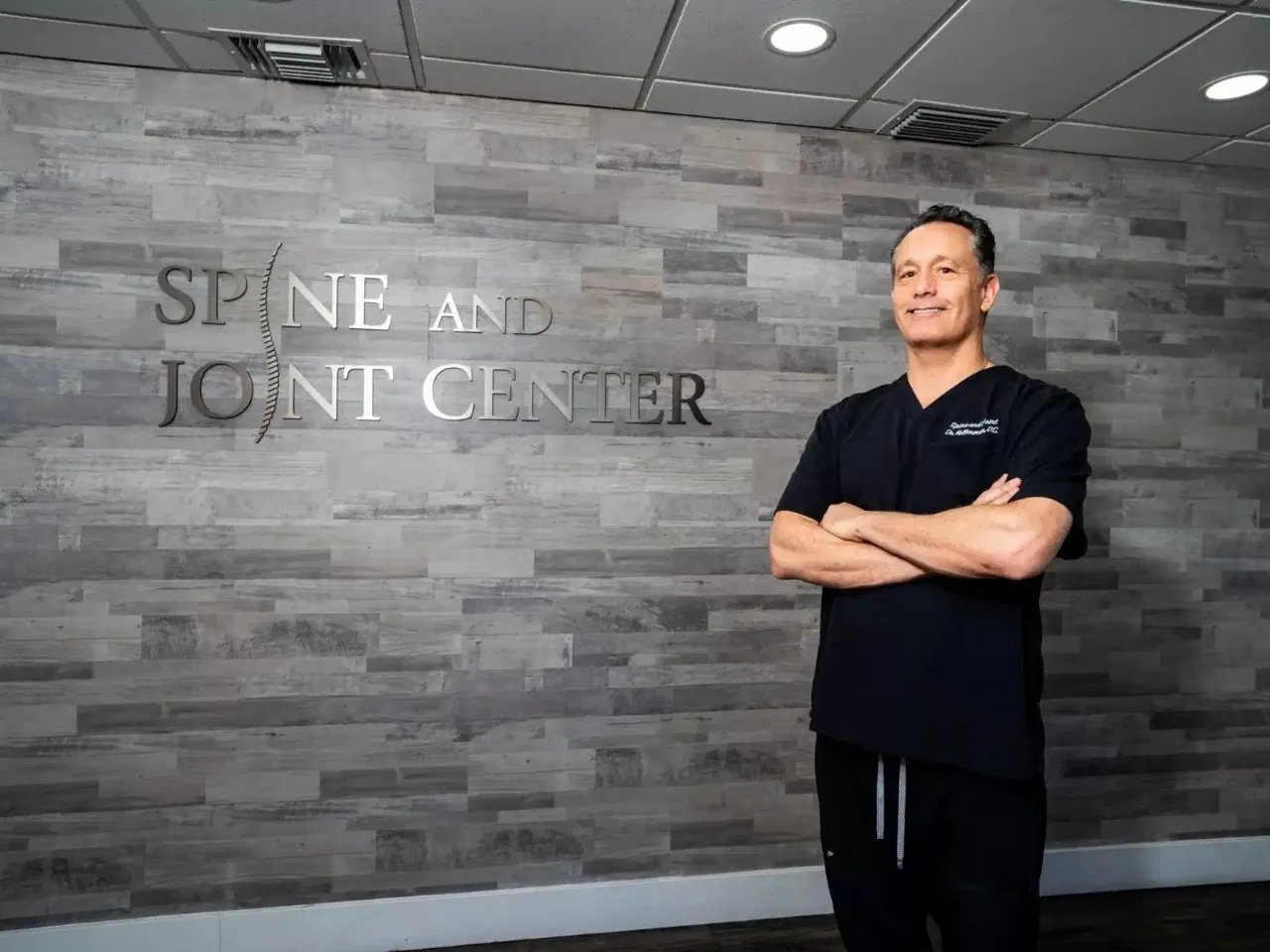
Douglas Kellerman, D.C.
Licensed chiropractic physician in Florida. Gonstead technique, spinal decompression and rehabilitation.

Michael F. Petrie, D.C.
Licensed chiropractic physician in Florida. Diversified and Activator methods, auto accident injury care.
Questions after a collision
Request an appointment
Call the office at (954) 561-4700, or request an appointment online. Same-week appointments are often available.
Finding the office
410 NE 44th St, Oakland Park, FL 33334 · (954) 561-4700 · Mon–Thu 9:00–13:00 and 14:30–18:00, Fri–Sat 9:00–13:00
Care is provided by Douglas Kellerman, D.C. and Michael F. Petrie, D.C., licensed chiropractic physicians in the State of Florida.
What should I know after a collision?
How soon after a collision should I be seen?
Within the first few days, especially where neck stiffness or headache is increasing. Florida PIP requires initial services within 14 days of the crash for coverage to apply.
What happens after I book?
You get an email confirmation straight away with the address and arrival details. There is no call back to wait for, and you can change the time from that email.
Will I need X-rays?
Not always. X-rays are taken where medically necessary after the examination, not as a routine first step.
Book your visit
Choose a time and you will get an email confirmation straight away.
Mechanism of injury
What happens to the neck, in four positions
In a rear-end collision the body is moved before the head can follow it. The neck is carried through the four positions below, in this order.

1Resting posture 
2Moment of impact 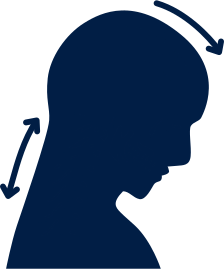
3Hyperflexion 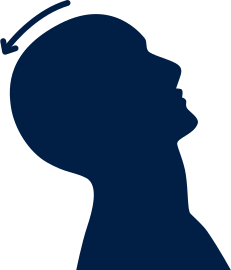
4Hyperextension
These illustrations describe a mechanism of injury. They are not a diagnosis, and they do not predict how any individual patient will be affected.