
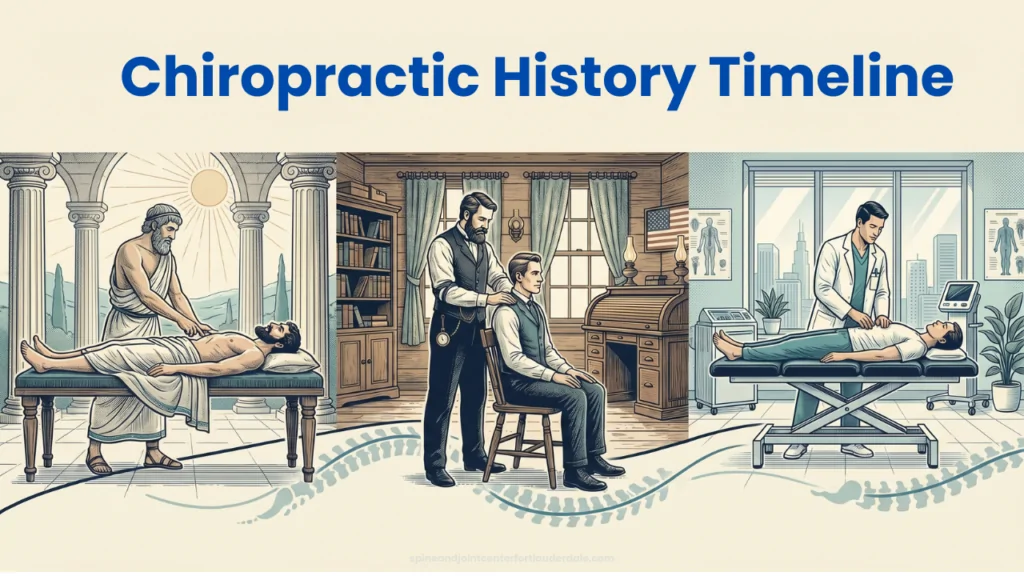
Chiropractic History Timeline: From 1895 to 2026
By Dr. Douglas Kellerman, DC | Medically Reviewed By Dr. Michael F. Petrie, DC | Last Updated: May 2026
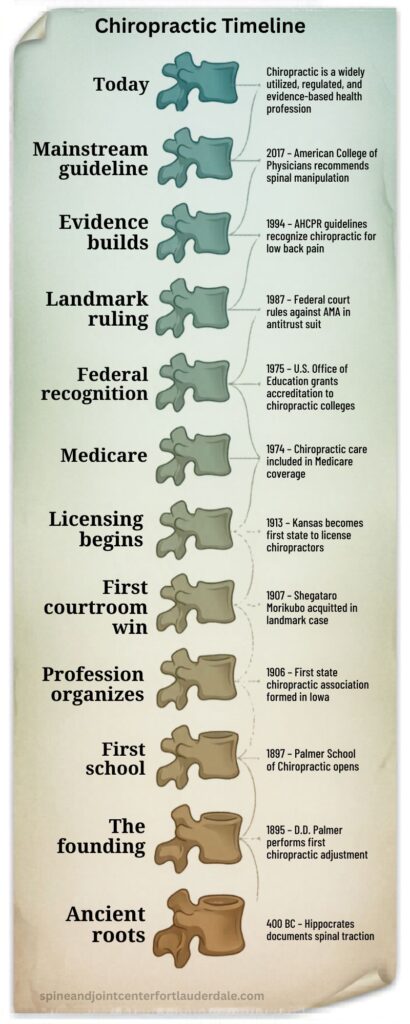
Chiropractic began with a single spinal adjustment in Davenport, Iowa, on September 18, 1895, when Daniel David Palmer treated a partially deaf janitor named Harvey Lillard. Over the 130 years that followed, that one hands-on technique grew into a licensed, regulated, evidence-informed health profession practiced in all 50 states.
This timeline traces that long arc. The story blends pioneers and self-taught healers, courtroom battles that nearly ended the profession, scientific turning points that brought it into mainstream care, and the market forces still shaping where chiropractic sits in 2026. Each milestone helps explain why modern chiropractic looks the way it does — structured, accountable, and increasingly studied.
A Timeline: From Hippocrates to 2026
Tap any point on the timeline to travel through 2,400+ years of spinal care.
Hippocrates documents spinal care
The Greek physician Hippocrates describes spinal examination and traction in his writings — hands-on spinal care thousands of years before chiropractic had a name.
The first chiropractic adjustment
D.D. Palmer performs the first documented chiropractic adjustment in Davenport, Iowa, treating janitor Harvey Lillard — the moment recognized as the birth of the profession.
The Palmer School opens
Palmer founds the first formal chiropractic school in Davenport, Iowa, creating the first structured curriculum in spinal mechanics and adjustment technique.
B.J. Palmer takes leadership
B.J. Palmer assumes leadership of the profession, expanding training and organizing chiropractic into a network of formal schools with standardized curricula.
First major courtroom victory
In the Wisconsin trial of Tom Morikubo, a court recognizes chiropractic as distinct from the practice of medicine — the profession’s first significant legal win.
Kansas licenses chiropractors
Kansas enacts the first state chiropractic licensing law, creating a regulatory template that other states would follow over the next six decades.
39 states grant recognition
By 1931, 39 states have given chiropractors legal recognition — steadily building a regulated, accountable profession across the country.
Medicare covers chiropractic
Congress authorizes Medicare coverage for chiropractic care, reducing access barriers for older adults and signaling broad insurance recognition.
Federal recognition & all 50 states
The U.S. Office of Education recognizes the Council on Chiropractic Education, and Louisiana becomes the final state to license chiropractic.
The Wilk v. AMA ruling
A federal court rules that the American Medical Association unlawfully conspired to restrain trade against chiropractors — a decision affirmed on appeal in 1990.
The RAND study
The RAND Corporation publishes a landmark review supporting spinal manipulation for short-term relief of uncomplicated, acute low back pain.
A recommended first-line option
The American College of Physicians names spinal manipulation a recommended first-line option for low back pain, alongside exercise and heat.
A mainstream profession
Roughly 70,000 chiropractors are licensed across the U.S., with care recognized in all 50 states and integrated into mainstream, evidence-informed healthcare.
Tap a milestone below — or focus the timeline and use the ← → arrow keys.
For local readers, that history has a direct line to today: Spine and Joint Center is located at 410 NE 44th St in Oakland Park, just minutes from downtown Fort Lauderdale, serving patients across Broward County.
Key Takeaways
- 1895: D.D. Palmer performs the first documented chiropractic adjustment, founding chiropractic as a distinct profession.
- Early 1900s: Formal schools and state licensure emerge, standardizing education and practice.
- 1970s: Federal recognition of chiropractic education, Medicare coverage, and licensure in all 50 states move chiropractic into mainstream healthcare.
- Late 20th century: The Wilk v. AMA antitrust ruling and a growing research base raise professional credibility.
- 2000–2026: Clinical guidelines, the opioid crisis, and multidisciplinary collaboration position chiropractic as a recognized first-line option for back pain.
The Ancient Origins of Spinal Manipulation (Before 1895)
Spinal manipulation predates D.D. Palmer by thousands of years. Long before chiropractic had a name, healers across many cultures used their hands to restore movement and ease pain. These traditions did not share a single theory — they shared practical, repeatable knowledge about alignment and mobility, which helps explain why hands-on spinal care kept reappearing in different places and eras.
How Hippocrates Practiced Spinal Therapy Around 400 BC
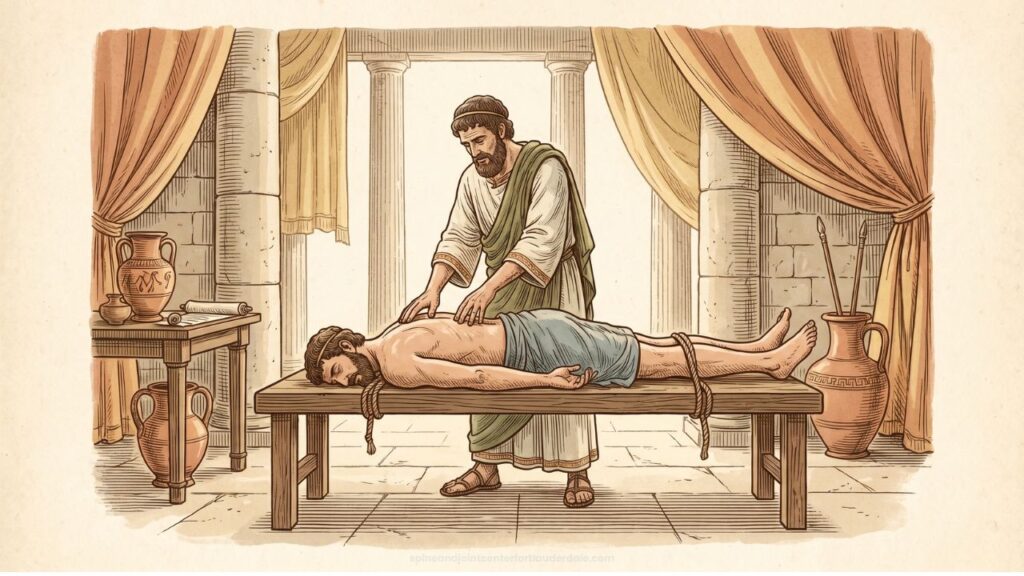
Hippocrates of Kos, writing around 400 BC, described spinal examination and traction in texts such as On Fractures and On the Articulations. His approach emphasized careful observation, palpation, and graded, incremental force meant to reduce deformity while protecting mobility — early principles of caution that still echo in modern practice.
| Aspect | Hippocratic approach |
|---|---|
| Examination | Visual inspection, palpation, limb testing |
| Intervention | Traction, manipulation, splinting |
| Safety | Gradual force, anatomical reasoning, awareness of contraindications |
Bonesetters of Medieval Europe and Ancient Asia
Where formal medical schools were scarce, practical “bonesetters” kept joint and spinal care alive. Monastic infirmaries in medieval Europe recorded hands-on techniques, and Asian texts describe manipulative methods used within Daoist and Ayurvedic traditions. These were pragmatic maneuvers aimed at restoring function — not mystical remedies. Outcomes depended heavily on practitioner skill and patient selection, and without modern anatomical knowledge or safety standards, risk was higher. That variability is precisely what later reformers like Palmer set out to address through training, documentation, and regulation.
Indigenous Spinal Healing Traditions in the Americas
Similar manual techniques appear in the medical traditions of the Indigenous Americas. Ethnohistoric accounts associated with the Maya, the Inca, and several North American tribes describe manual adjustment, traction, and massage as part of established healing practice, with knowledge passed down through community elders rather than formal schools.
| Region | Technique | Notes |
|---|---|---|
| Maya (c. 250–900 CE) | Joint mobilization | Practitioner training by elders |
| Inca (c. 1400s) | Traction and massage | Integrated with herbal care |
| Plains tribes (18th–19th c.) | Manual realignment | Emphasis on gradual force |
September 18, 1895: The First Chiropractic Adjustment
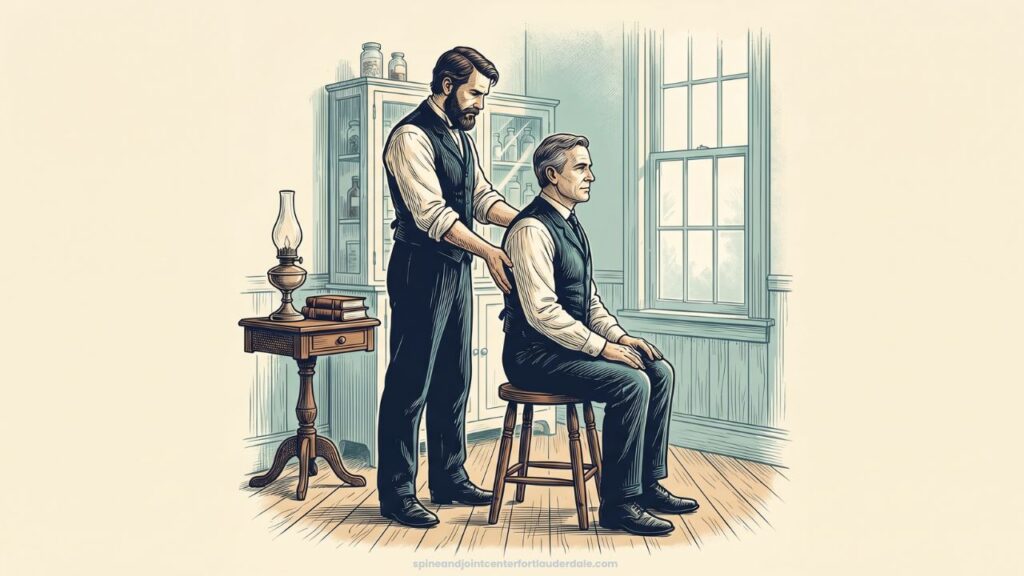
On September 18, 1895, D.D. Palmer performed what is recognized as the first chiropractic adjustment in Davenport, Iowa. The date marks both a specific clinical act and the symbolic founding of a new health profession.
Who Was Daniel David (D.D.) Palmer?
Daniel David Palmer was a self-taught healer whose ideas were shaped by magnetic healing, physiology, and 19th-century theories of the body as a self-regulating system. He proposed that spinal alignment influenced nervous-system function — an idea that became the foundation of early chiropractic principles. Palmer organized his teaching into what became Palmer College in Davenport, and his son B.J. Palmer expanded the school’s reach over the following decades.
| Year | Influence / event | Outcome |
|---|---|---|
| 1860s–90s | Magnetic healing practice | Focus on the nervous system |
| 1895 | First adjustment | Founding date |
| 1897 | Palmer School founded | First formal curriculum |
| 1906–1961 | B.J. Palmer’s leadership | Professional growth |
The Story of Harvey Lillard and the Restored Hearing
Palmer’s first recorded adjustment involved Harvey Lillard, a Davenport janitor who reported long-standing hearing loss. Palmer identified what he described as a spinal lesion in the upper back and applied a manual adjustment, after which Lillard reported a change in his hearing. It is important to read this account in context:
- The account: Lillard’s reported improvement became the origin story Palmer used to link vertebral mechanics to nervous-system function.
- The caution: This was a single observational case, not a controlled study. Later legal and scientific scrutiny — including Wilk v. AMA and decades of research review — pushed the profession toward evidence-based standards.
Why September 18, 1895 Is Recognized as the Profession’s Birth Date
That single documented adjustment — a specific date, a named patient, and a recorded outcome — gave chiropractic a clear origin point. It is why the profession marks September 18, 1895 as its founding moment. The event prompted B.J. Palmer and institutions like Palmer College to formalize education and methods, turning a one-off technique into a teachable, regulated discipline.
1897: The Palmer School of Chiropractic in Davenport, Iowa
In 1897, D.D. and B.J. Palmer turned a single technique into the first formal chiropractic curriculum, built around spinal mechanics, palpation, and vertebral analysis. Davenport soon earned the nickname “The Fountainhead” of chiropractic.
The First Chiropractic Curriculum and Early Teaching Methods
Early chiropractic education was practical and observation-driven. Students learned spinal assessment and adjustment technique through hands-on apprenticeship alongside lectures and anatomy study, and — as the technology emerged — basic radiography. That structure created measurable competencies and standardized practice, which reduced risk and laid the groundwork for later regulation.
- Practical spine and nervous-system evaluation in training
- Apprenticeship-style mentoring paired with lecture hours
- Early adoption of radiography and patient record-keeping
- Systematic adjustment protocols with outcome tracking
Davenport, Iowa: Why It Became “The Fountainhead”
Davenport became the natural home of chiropractic because Palmer founded his school there in 1897. The town offered rail access, a steady supply of early patients, and a supportive Midwestern community — conditions that let the profession formalize training and standards. B.J. Palmer’s leadership from 1906 onward expanded the curriculum and cemented Davenport’s central role.
| Year | Milestone |
|---|---|
| 1895 | D.D. Palmer’s first adjustment |
| 1897 | Palmer School founded |
| 1906 | B.J. Palmer begins expanding the curriculum |
| 1972 | Medicare authorized to cover chiropractic care |
| 1987 | Wilk v. AMA federal ruling |
The First Graduating Classes and Their Geographic Spread
The first Palmer School graduates carried the new training model outward from the Midwest. Early practitioners established clinics across Illinois, Wisconsin, Ohio, and New York. They did so without state licensing laws in place — which made legal disputes common and set the stage for the regulatory battles of the next two decades.
The Early 1900s: The Era of Persecution
The early 1900s were a legal battleground for chiropractic. Chiropractic historians estimate that more than 12,000 practitioners were arrested or prosecuted before states established licensing — most often charged with practicing medicine without a license. That pressure directly fueled the push for licensing statutes and standardized education.
How Many Chiropractors Were Jailed Before State Licensing?
Historical reviews estimate more than 12,000 chiropractic arrests and prosecutions occurred before licensing laws took hold. The figure is drawn from contemporary reports and later historical scholarship rather than a single official registry, so it is best read as an informed estimate. Either way, the legal climate clearly drove the profession toward formal statutes, examinations, and educational standards.
B.J. Palmer Takes Leadership of the Profession in 1906
In 1906, B.J. Palmer assumed leadership of the profession, expanding training at Palmer College and organizing resistance to medical prosecution. Under his direction, chiropractic grew from a small group of practitioners into a network of formal schools with standardized curricula by the 1910s — institutional growth that made modern, regulated chiropractic possible.
The 1907 Wisconsin Morikubo Trial and the First Major Legal Victory
The 1907 Wisconsin trial of Minora “Tom” Morikubo delivered the profession’s first significant courtroom win. Charged with practicing medicine without a license, Morikubo’s defense argued that chiropractic was a distinct discipline. The court agreed.
- Case: State v. Morikubo (Wisconsin, 1907)
- Outcome: Chiropractic recognized as separate from the practice of medicine
- Impact: Fewer prosecutions and a clearer path toward state licensing
1913–1930s: State Licensing and the Path to Recognition
Over roughly two decades, chiropractic shifted from contested local practice to a regulated profession. State boards and minimum educational standards began to formalize training, testing, and discipline — building the legal foundation that later federal recognition would rest on.
Kansas Becomes the First State to License Chiropractors (1913)
In 1913, Kansas enacted the first state chiropractic licensing law, creating a template other states would follow. The Kansas framework defined training and examination requirements and established a regulatory board — measures that reduced legal risk for practitioners and increased public confidence in care.
Florida Establishes Chiropractic Licensure
Florida joined the wave of states formalizing chiropractic practice during this era, enacting a chiropractic practice act that defined the scope, set penalties for unlicensed practice, and created the precedent for state oversight. For patients in Fort Lauderdale and Broward County, that early regulation meant safer, more consistent care from licensed practitioners — and it laid the groundwork for the modern Florida Board of Chiropractic Medicine.
How State Boards and Educational Standards Took Shape
As regulations tightened after 1913, licensing boards became the engine that professionalized chiropractic. Patchwork local laws gave way to more uniform expectations: schools strengthened curricula, examinations were standardized, and boards enforced licensing requirements covering anatomy, diagnosis, ethics, and clinical hours. Today’s licensure and education requirements trace directly back to this period.
The 1920s–1940s: Straight Chiropractic vs. Mixer Chiropractic
By the 1920s, a clear philosophical split had emerged. “Straight” chiropractors held that the spinal adjustment was the sole legitimate therapeutic act. “Mixers” broadened practice to include physiotherapy, nutrition, and soft-tissue work. That debate shaped education, licensing, and public perception — and still influences practice patterns today.
Straight Chiropractic and the Pure Adjustment Philosophy
Straight chiropractors emphasized the “pure adjustment”: precise manual correction of the spine, a limited scope of practice, and a strong reliance on subluxation theory. Influenced by B.J. Palmer, the straight tradition focused training on adjustment technique and helped define professional scope boundaries that influenced licensure debates for decades.
Mixer Chiropractic and the Integration of Therapeutic Modalities
Mixers blended manual adjustment with additional therapies — physiotherapy, massage, nutrition, and later X-ray diagnostics — to broaden the options available to each patient. This approach emphasized measurable outcomes and collaboration with other health disciplines, and it laid the groundwork for the evidence-informed, multidisciplinary care common in Fort Lauderdale practices today.
| Era | Focus | Emphasis |
|---|---|---|
| 1920s | Manual adjustment + massage | Observation, conservative care |
| 1930s | Nutrition added | Screening, dietary guidance |
| 1940s | X-ray diagnostics | Imaging used with caution |
How Modern Practices Combine Both Traditions
Modern care draws on both schools. Spine and Joint Center pairs the straight tradition’s precision in spinal alignment and adjustment with the mixer tradition’s use of evidence-supported adjuncts such as decompression and acupuncture. The result is measured, safety-minded care that tracks function and pain over time using validated tools — respect for history paired with data-driven practice.
Post-War Growth: 1947–1963 and the Rise of Scientific Inquiry
After World War II, demand for drug-free spinal care rose sharply among veterans and civilians alike, and chiropractic expanded quickly between 1947 and 1963. National organizations and early accreditation efforts began pushing the field toward standardized education and scientific inquiry.
Founding of the International Chiropractors Association in 1926
The International Chiropractors Association (ICA), founded in 1926 by B.J. Palmer, helped organize the profession. It advocated education benchmarks, promoted codes of ethics and practice standards, lobbied state legislatures for licensure laws, and provided a national voice during disputes with medical organizations.
The Council on Chiropractic Education and Academic Accreditation
The drive for formal academic standards has deep roots: a predecessor body, the Council on Education, formed in 1947 to raise curriculum and clinical-training requirements. That work eventually produced the modern Council on Chiropractic Education (CCE), which the U.S. Office of Education formally recognized as an accrediting agency in 1974. CCE accreditation aligned chiropractic programs with the expectations applied to other health professions.
Veterans’ Demand for Drug-Free Care After World War II
Many returning World War II veterans sought care that reduced reliance on medication and invasive procedures. That demand pushed clinics toward conservative options such as spinal manipulation and rehabilitative exercise, raised enrollment at chiropractic colleges, and encouraged early research into safety and outcomes.
The 1970s: Federal Recognition Changes Everything
The 1970s were a watershed decade. Three milestones — federal recognition of chiropractic education, Medicare coverage, and licensure in all 50 states — together moved chiropractic from the margins into federally recognized health care.
The U.S. Office of Education Recognizes Chiropractic Education
In 1974, the U.S. Office of Education formally recognized the Council on Chiropractic Education as an accrediting agency. That recognition standardized curricula, improved student access to federal loans and research grants, and strengthened chiropractic’s standing alongside other health professions.
Medicare Adds Chiropractic Services as a Covered Benefit
In 1972, Congress authorized Medicare coverage for chiropractic care, with services beginning in the years that followed. The provision covered spinal manipulation for active neuromusculoskeletal conditions and created billing standards — reducing access barriers for older adults and signaling broader insurance recognition. For Fort Lauderdale and Broward County, it meant greater insurance parity and clearer, regulated care pathways.
All 50 States Have Licensed Chiropractic by 1974 — Louisiana the Last
In 1974, Louisiana became the final state to enact a chiropractic licensing law, completing a decades-long, state-by-state process that had begun in the early 1900s. With licensure in place nationwide, education and safety expectations became consistent from coast to coast — the foundation for modern regulatory oversight.
Wilk v. AMA (1976–1990): The Landmark Antitrust Victory
For years, organized medicine actively worked to limit chiropractic. The Wilk v. AMA case challenged that conduct in federal court — and reshaped how the two professions relate.
How the American Medical Association Tried to Suppress Chiropractic
From the 1960s into the 1980s, the American Medical Association discouraged physicians from referring patients to or cooperating with chiropractors. In 1976, chiropractor Dr. Chester Wilk and four colleagues filed an antitrust suit alleging an illegal conspiracy to restrain trade. Discovery revealed internal AMA documents describing a coordinated campaign against the chiropractic profession.
The 1987 Federal Court Ruling by Judge Susan Getzendanner
In 1987, U.S. District Court Judge Susan Getzendanner ruled that the AMA had violated federal antitrust law by engaging in an unlawful conspiracy “to contain and eliminate the chiropractic profession.” She issued a permanent injunction against the AMA. Notably, the court did not rule on whether chiropractic was effective — only that the boycott itself was illegal.
The 1990 Final Appeals Decision and Its Lasting Impact
The U.S. Court of Appeals affirmed the judgment in 1990, making the decision final. Its effects were lasting:
- Limited organized medicine’s boycott of chiropractic referrals
- Opened hospital privileges and insurance participation to chiropractors
- Encouraged peer-reviewed research and inclusion of chiropractic in spinal-care guidelines
- Strengthened the profession’s ability to integrate into mainstream healthcare
The 1990s–2000s: Insurance Coverage and Mainstream Acceptance
Through the 1990s and 2000s, chiropractic moved from professional isolation into broader medical acceptance, driven by influential research and expanding insurance coverage.
The 1992 RAND Study and the 1994 Federal Guideline
In 1992, the RAND Corporation published a landmark review of spinal manipulation for low back pain. It concluded that manipulation offers short-term benefit for uncomplicated, acute low back pain, while noting that evidence for chronic pain was insufficient. That analysis helped inform the federal government’s 1994 clinical practice guideline on low back pain, which included spinal manipulation among recommended options — a major step toward mainstream acceptance. Patients exploring conservative options today can read more about back pain relief in Fort Lauderdale.
Inclusion in the U.S. Department of Defense and VA Healthcare Systems
By the 1990s, the U.S. military and Department of Veterans Affairs began integrating chiropractic care into their health systems. Department of Defense facilities added chiropractic services at selected bases between 1992 and 2000, and the VA expanded access in the early 2000s. For service members and veterans, this opened a non-drug care option alongside conventional treatment.
Major Insurance Carriers Add Chiropractic Coverage Nationwide
As federal programs adopted chiropractic, major commercial insurers followed. Carriers broadened their networks through the late 1990s and 2000s, embedding chiropractic in employer health plans. Coverage made care more accessible across Broward County — including for people recovering from injuries such as an auto accident, where insurance pathways matter most.
The Evidence-Based Era: 2007 to 2020
Between 2007 and 2020, chiropractic moved firmly into evidence-based practice as hospitals and national guideline panels increasingly recommended non-drug care for musculoskeletal pain.
The Joint Commission Strengthens Non-Drug Pain Standards
The Joint Commission — the body that accredits most U.S. hospitals — progressively strengthened its pain-management standards. Revisions taking effect in 2018 directed hospitals to make non-pharmacologic pain treatments available and to document functional goals and informed consent. That shift helped integrate manual therapies into multidisciplinary, safety-focused pain programs.
The 2017 American College of Physicians Guidelines for Low Back Pain
In 2017, the American College of Physicians released a clinical practice guideline that shifted national recommendations toward non-drug care first for low back pain — explicitly including spinal manipulation, exercise, and heat among recommended first-line options. For patients seeking evidence-based care, this established spinal manipulation as a supported early choice for both acute and chronic low back pain. The same conservative-first thinking applies to related conditions such as sciatica and a herniated disc.
The Opioid Crisis and Chiropractic as a First-Line Option
As opioid-related harm rose, clinicians and policymakers increasingly looked to conservative care as an early step in pain management. Research published between 2017 and 2020 linked seeing a chiropractor first to fewer opioid prescriptions for some patients. Coordinated care with primary clinicians and clear outcome tracking remains essential — chiropractic is one part of a safe, evidence-informed plan, not a replacement for medical evaluation.
Chiropractic by the Numbers: 2026 Statistics and Market Size
The scale of chiropractic in 2026 helps frame where it sits alongside medicine and physical therapy.
How Many Licensed Chiropractors Practice in the United States?
Roughly 70,000 chiropractors are licensed in the United States, with about 41,000 actively employed in clinical practice according to the U.S. Bureau of Labor Statistics. The profession has grown steadily from an estimated 49,000 practitioners in 2000, supported by stronger education standards and rising public awareness.
How Many Americans Receive Chiropractic Care Each Year?
About 35 million Americans receive chiropractic care each year, according to the American Chiropractic Association. That scale means patients encounter varied delivery models — solo offices, multidisciplinary clinics, and hospital-affiliated programs — which affects both access and cost. Research links chiropractic care to reduced low back pain and improved function for many people, though these are likely outcomes rather than guarantees.
How Large Is the U.S. Chiropractic Industry?
Industry analyses estimate the U.S. chiropractic sector generates roughly $19–20 billion in annual revenue. That figure reflects rising demand, wider insurer coverage, and a demographic shift toward conservative spine care. Spinal manipulation, rehabilitation, and adjunctive therapies make up the bulk of services delivered.
Patient Satisfaction Compared to Other Specialties
Surveys and peer-reviewed studies report that patient satisfaction for spinal complaints often matches or exceeds primary care and physical therapy on measures such as communication, time spent, and symptom improvement, with many samples reporting satisfaction in the 80–90% range. As with any care decision, satisfaction data is best weighed alongside clinical evidence and individual risk.
Athletes and Public Figures Who Use Chiropractic Care
Chiropractic care has become a visible part of mainstream sports and public life — a shift that reflects, rather than proves, its growing acceptance.
All 32 NFL Teams Have an Affiliated Team Chiropractor
According to the Professional Football Chiropractic Society, all 32 NFL teams provide chiropractic services to players and staff as part of injury management and prevention. Team chiropractors work alongside physicians, physical therapists, and athletic trainers, with care focused on measurable outcomes such as days missed and re-injury rates.
Olympic and Professional Athletes Who Credit Chiropractic Care
Many Olympic and professional athletes use chiropractic care as part of training and recovery, describing improved joint mobility and reduced reliance on pain medication. Athletes value it for both injury management and maintenance — a model of sports injury chiropractic care that emphasizes function and prevention. As with all care, individual results vary and depend on careful evaluation.
Public Visibility and Its Limits
Beyond sports, chiropractic care has drawn attention from a range of public figures over the decades, which has helped normalize the profession in mainstream culture. It is worth keeping these endorsements in perspective: public visibility is not the same as clinical evidence. The strongest case for chiropractic rests on research, clinical guidelines, and documented outcomes — not celebrity association.
Chiropractic in Fort Lauderdale and the Legacy of Spine and Joint Center
Florida’s organized profession — through the Florida Chiropractic Association and state licensure — has long shaped the patient protections and standards that matter across Broward County.
Florida’s Chiropractic Profession and Patient Protection
Florida’s chiropractic regulation centers on licensing, defined scope of practice, continuing-education requirements, and disciplinary procedures enforced by the state board. The Florida Chiropractic Association has long advocated for standards that protect the public. Local clinics follow these state rules — and Spine and Joint Center is located at 410 NE 44th St in Oakland Park, just minutes from downtown Fort Lauderdale, serving patients across Broward County.
How Dr. Petrie and Dr. Kellerman Continue the Profession’s Legacy
The profession’s local legacy is visible in clinicians who have stayed the course. Dr. Michael F. Petrie, DC brings more than 47 years of practice, and Dr. Douglas Kellerman, DC adds more than 30 years — a combined 77+ years of chiropractic experience in Broward County. They use established techniques including Gonstead, Activator, Diversified, decompression, and acupuncture, with an emphasis on patient education, measurable outcomes, and thorough examination. You can learn about the doctors and history of Spine and Joint Center on the practice’s About page.
47+ Years of Continuous Service at the Same Fort Lauderdale Location
Spine and Joint Center has provided continuous care from the same Fort Lauderdale-area location for more than 45 years. That longevity supports continuity of records and consistent follow-up, a stable point of access for patients across Broward County, and the kind of long-term community trust that this 130-year history has always been built on.
Frequently Asked Questions
How did chiropractic influence other manual therapies like osteopathy and physical therapy?
Chiropractic helped popularize a spinal and nervous-system focus and structured manual techniques. Over time, this contributed to manual therapy being integrated into the curricula of osteopathy and physical therapy, along with shared research and more evidence-informed, hands-on approaches across all three professions.
What training and licensing differences existed between early chiropractors?
Early chiropractors trained unevenly. Before standardized education, apprenticeships were common, program length varied widely, and licensing differed from state to state. Standardized curricula, formal accreditation, and licensing examinations emerged only later, gradually improving consistency and patient safety across the profession.
When did Medicare start covering chiropractic care?
Congress authorized Medicare coverage for chiropractic care in 1972, with services beginning in the years that followed. Coverage focused on spinal manipulation for active neuromusculoskeletal conditions. This recognition reduced access barriers for older adults and signaled broader insurance acceptance of chiropractic care.
What was the significance of the Wilk v. AMA case?
In Wilk v. AMA, a federal court ruled in 1987 — affirmed on appeal in 1990 — that the American Medical Association had unlawfully conspired to restrain trade against chiropractors. The decision opened referral pathways, hospital privileges, and insurance participation, helping chiropractic integrate into mainstream healthcare.
How have malpractice claim rates for chiropractors changed since 1980?
Analyses of insurance data indicate that chiropractic malpractice claim rates have remained relatively low and stable since 1980. Improved education standards, clinical guidelines, and risk-management practices are generally credited with supporting this consistent professional liability record over time.
This information is provided for educational purposes only and does not constitute medical advice. Individual results may vary. Consult a qualified healthcare professional before beginning any treatment program.
Ready for Relief? Schedule Today
More than 45 years of trusted chiropractic care at the same Fort Lauderdale-area location. Schedule Your Appointment, or call (954) 561-4700. Get Directions →
Sources & References
- RAND Corporation — “Changing Views of Chiropractic” / Spinal Manipulation for Low-Back Pain. rand.org/pubs/research_briefs/RB4539.html
- American College of Physicians — “Noninvasive Treatments for Acute, Subacute, and Chronic Low Back Pain” (2017), Annals of Internal Medicine. acpjournals.org/doi/10.7326/M16-2367
- Wilk v. American Medical Association, 671 F. Supp. 1465 (N.D. Ill. 1987) — Justia primary court record. law.justia.com/cases/federal/district-courts/FSupp/671/1465/
- U.S. Bureau of Labor Statistics — Occupational Outlook Handbook: Chiropractors. bls.gov/ooh/healthcare/chiropractors.htm
- Council on Chiropractic Education — Historical Development. cce-usa.org/history.html
- U.S. Congress — legislative record noting Medicare chiropractic coverage established in 1972. congress.gov
- World Federation of Chiropractic — History of Chiropractic. wfc.org/history
- American Chiropractic Association — Key Facts About the Chiropractic Profession. acatoday.org
- Professional Football Chiropractic Society / Foundation for Chiropractic Progress — NFL chiropractic involvement. f4cp.org
- Palmer College of Chiropractic — Institutional history. palmer.edu